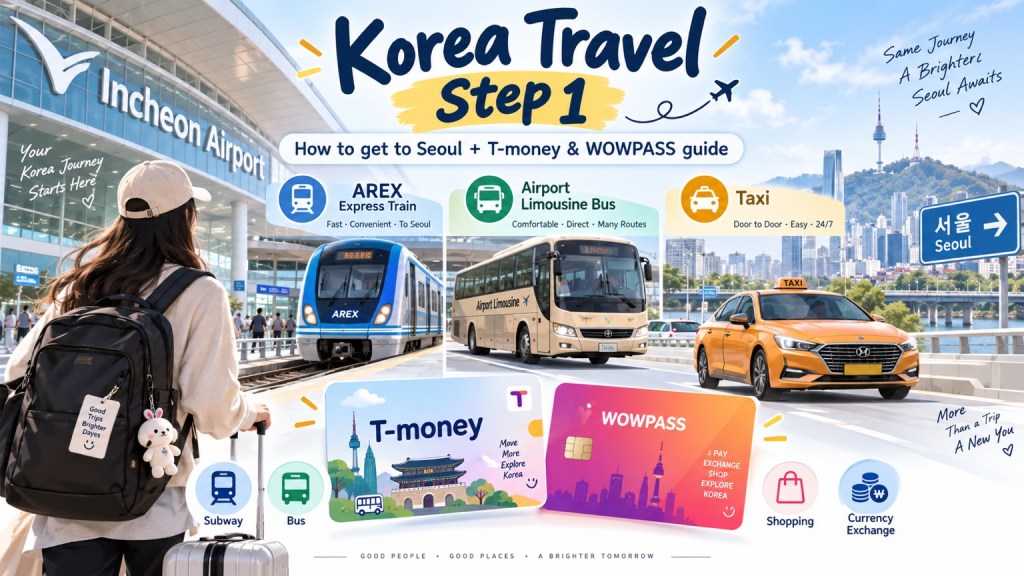
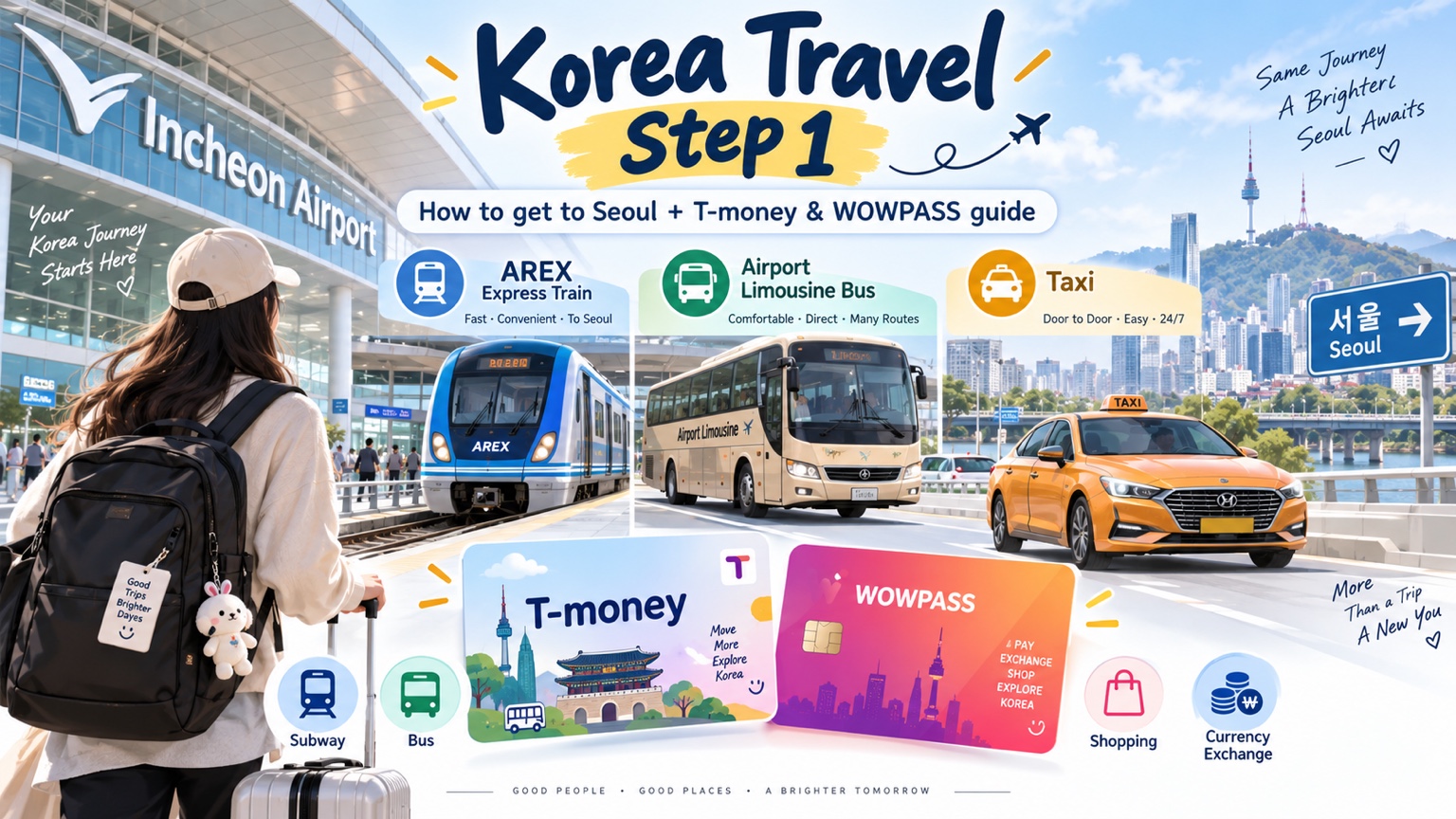
KOREA TRAVEL · STEP 1 / Last checked: 8 September 2026 · 한국어 요약
You have landed at Incheon International Airport (인천국제공항). Your next job is not to buy every travel pass: it is to reach your accommodation with a working transport card. This guide helps you choose an airport transfer, understand T-money and WOWPASS, and get through Seoul Station without following the wrong crowd.
This is a researched planning guide, not a claimed personal trip report. Prices are in Korean won (KRW), normally per adult one way unless stated otherwise. Check the operator before paying. Links currently lead to ordinary official or booking pages; no affiliate discount or commission arrangement is claimed.
The 30-second decision
Staying in Hongdae? Start by checking the AREX All-stop train directly to Hongik Univ. Want a reserved seat to Seoul Station? Choose Express. Hotel beside a limousine stop? A bus may save you a difficult subway transfer. Several people, awkward luggage or a very late arrival? Compare an official taxi quote with the total group fare.
Card choice: a simple T-money card plus your existing payment card is a sensible starting point. WOWPASS is optional: consider it if its prepaid shopping balance, exchange options or supported app top-ups solve a real problem for you.
Jump to: Airport transport · Cards and balances · Where to buy · Seoul Station Survival Guide · Gate trouble · 15-minute re-entry · FAQ
1. Incheon Airport to Seoul: which transport fits your hotel?
| Option | Fare and journey time | Best fit / trade-off |
|---|---|---|
| AREX Express 직통열차 | ₩13,000 advertised adult fare. T1–Seoul Station 43 minutes; T2–Seoul Station 51 minutes. | Reserved seat, useful for Seoul Station connections. No Hongdae stop; another journey may be needed after arrival. |
| AREX All-stop 일반열차 | Transport-card fare to Seoul Station: T1 ₩4,750; T2 ₩5,350. Approximately 59 / 66 minutes; some services take 2–6 minutes longer. | Lowest rail fare here; direct Hongik Univ. and Gongdeok stops. Unreserved seating and possible crowding. |
| Airport limousine bus 공항리무진 | Examples: routes 6001 and 6002, ₩17,000 adult. Allow roughly 60–120+ minutes as a planning estimate, depending on stop and traffic. | Good when the exact stop is close to your hotel. Luggage storage and fewer transfers; road congestion and waiting matter. |
| Taxi 택시 | Standard Seoul taxi: daytime meter starts at ₩4,800, not the airport trip price. Official International Taxi standard zone fares currently show ₩70,000–95,000. Allow roughly 60–100+ minutes as a planning estimate. | Door-to-door convenience for groups or heavy bags. Confirm vehicle capacity, total fare, tolls and any extra charges. |
Check the AREX Express overview, All-stop overview and current All-stop fare table. Bus examples come from route 6001 and route 6002. Taxi references: airport taxi guide and International Taxi zone fares.
Buying and boarding the train
In either terminal, follow Airport Railroad / 공항철도 signs to the B1 Transportation Center. Read the service name before approaching a gate. Express has its own ticket and reserved seat; a normal T-money tap is not an Express booking. The operator lists Express customer information counters at both terminals’ B1 Transportation Centers. See the official boarding locations.
For All-stop, use a loaded compatible transport card. A single-journey card is an alternative: the official tariff adds ₩100 to the adult card fare and a refundable ₩500 deposit. Keep that card until after exiting and use the deposit-refund machine. A journey continuing onto the subway is not necessarily priced as two independent trips; the actual route and transfer handling matter. AREX fare rules.
Hongdae shortcut: choose Hongik Univ. / 홍대입구 as your destination, not Seoul Station. The official transport-card fare is ₩4,650 from T1 or ₩5,250 from T2. Going to Seoul Station first and then returning wastes travel time. Station-to-station fares.
When a bus beats a train
Look up your exact hotel address, then compare its walk from the bus stop against its walk from a subway exit. Route 6001 serves the Seoul Station/Myeongdong/Dongdaemun corridor; 6002 serves the Hongdae/Jongno corridor. Stop patterns differ by direction, so use the airport-to-city listing rather than assuming the return stop is opposite. See the operator’s route selector.
Buy the correct airport-departure ticket before queuing. In particular, the operator requires a ticket at T2’s B1 counter or vending machine, including routes 6001, 6002 and 6015, from 5 March 2026. Do not rely on old advice to just tap a card on board at T2. At T1, use the arrival-level bus ticket counters and confirm your platform. T2 ticket notice · airport bus guide.
Taxi and late-arrival checks
Use the designated taxi queue or your confirmed booked pickup, not an unsolicited offer in the terminal. For Seoul standard taxis, the airport lists night surcharges of 20% at 22:00–23:00 and 02:00–04:00, and 40% at 23:00–02:00. These rules are not a universal rate for every taxi class. Show the hotel’s Korean address and ask whether tolls are included; retain your receipt. Official airport taxi guidance.
For a fixed-price option, enter the exact destination in the official International Taxi booking form and compare the final quote, luggage capacity and cancellation terms. For late landings, check the train’s actual departure and your last subway connection. A train reaching Seoul does not guarantee that the next subway is still running. Do not prepay a tight connection based only on scheduled aircraft landing time.
Check before booking: official Express tickets · compare an AREX voucher listing. Compare terminal, direction, seat-reservation steps, expiry and refund conditions—not just the headline price. The Klook link is currently an ordinary, non-affiliate link.
2. T-money vs WOWPASS: understand the balances first
Image correction / 이미지 정정: The illustration below is conceptual, not an official product image. Its ₩5,000 WOWPASS price is outdated: the official purchase page currently shows ₩5,500 for machine pre-booking (₩6,000 reference price). T-money prices vary by product. Confirm pickup locations and supported services with the provider; transport and shopping balances are separate.
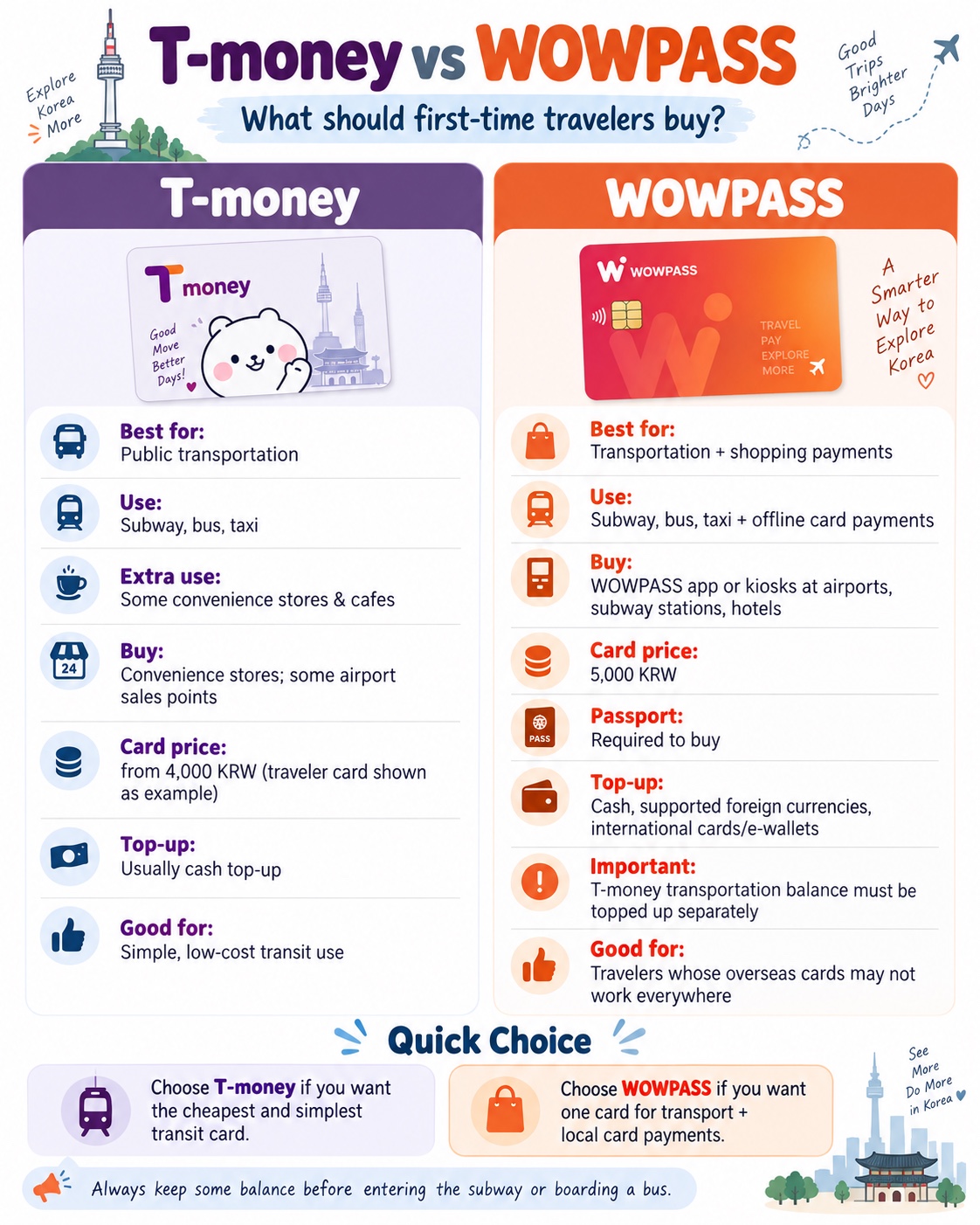
| Question | Ordinary T-money | WOWPASS with T-money |
|---|---|---|
| Card price | Typically ₩3,000–5,000; design/product varies. Stored travel value is extra. | Official booking page currently displays ₩5,500 pre-booked and ₩6,000 reference price. Bundles cost more and include different items. |
| Main purpose | Prepaid transport, plus participating T-money merchants. | Prepaid shopping payments plus a separate T-money transport function. |
| Funding | Bring KRW cash for the straightforward station-machine or convenience-store top-up route. | Supported cash/foreign-currency machines or supported international-card/e-wallet app funding for the WOWPASS payment balance. |
| At a subway gate | Fare comes from T-money value. | Fare still comes from T-money value—not automatically from the WOWPASS shopping balance. |
| What it is not | Not unlimited travel; not a general foreign-currency exchange wallet. | Not unlimited travel; not proof that every merchant or foreign card will work. |
Product references: Korea Tourism Organization transport-card guide, current WOWPASS purchase page and WOWPASS funding overview. Older guides can still show a ₩5,000 WOWPASS fee; use the current checkout price.
One physical WOWPASS card, two pots of money
| Shopping pot | Transport pot |
|---|---|
| WOWPASS payment balance For supported shop/card-terminal payments. | T-money balance For compatible subway and bus taps. |
| Supported app top-up: WOWPASS balance → explicit T-money top-up → scan the physical card to complete. This is a deliberate transfer, not an automatic shared balance. | |
On a compatible NFC phone, the official tutorial shows: open Tmoney Top-up, choose Top up with WOWPASS, scan the card, choose the amount and complete the requested scan. Keep it steady until success is displayed. Menus/device support can change; if the option is unavailable, use a supported cash top-up point instead. WOWPASS’s official app tutorial.
Example: seeing ₩50,000 under WOWPASS and ₩0 under T-money does not mean you can enter the subway. First fund the transport side and verify that balance. A separate ordinary T-money card is not automatically linked just because you installed the WOWPASS app.
How to top up and pay without surprises
For the simple cash method, hand the cashier your T-money card and KRW cash: “티머니 만 원 충전해 주세요” means “Please add ₩10,000 to my T-money.” At a recharge machine, select English, follow the displayed card-placement instructions, select the amount, insert accepted cash and wait for completion. Buying the plastic card and adding usable balance are different transactions. Ask the cashier to confirm the loaded amount.
T-money is accepted on compatible public transport and at merchants showing its logo; do not assume every restaurant accepts it. It does not replace a reserved Express or KTX ticket. For children/teens, ask about age registration instead of paying an adult fare by default. KTO card guidance.
WOWPASS supports foreign-currency cash at eligible machines and international-card/e-wallet app funding. The funding method, supported network, exchange rate and fee shown in the app matter; your bank may impose its own charge. Compare the final KRW received, not a marketing claim about “best” rates. Airport machines can have fewer functions than city machines. Keep a backup payment method and modest KRW cash. Official funding options.
3. Where to buy or collect cards at Incheon Airport
T-money: distinguish card sales from recharge service
T1: follow Airport Railroad signs toward the B1 Transportation Center and look for a transport-card vending/sales point near the All-stop area; ask specifically for T-money or the T-money-based Korea Tour Card. Do not assume a CU that recharges cards also sells that brand. T2: GS25 and 7-Eleven are reported purchase options; confirm stock at the counter before queuing for a train. These airport-specific observations are supported by an independent guide updated July 2026, not a live stock guarantee.
The official airport shopping directory lets you select your terminal and convenience stores. It lists store locations, not guaranteed T-money inventory. Show staff “티머니 카드 있어요?” (“Do you have T-money cards?”). If the available product is EZL/Cashbee instead, ask what you are buying; it is not branded T-money. If your preferred card is unavailable, ask the railway information counter about a single-journey ticket rather than buying an unnecessary bundle.
WOWPASS: choose a collection method before walking
The current official purchase selector offers airport CU pickup, an SKT roaming-center package and machine collection. Select your actual terminal first. CU pickup and machine issuance are different products: a pickup barcode does not mean you can collect at every machine or every CU.
For CU pickup, reserve in the app and show the barcode at the named branch after customs. The official service guide identifies a T1 example: CU branch #4, level 1, left of arrival hall F. Do not apply that T1 landmark to T2; use the T2 voucher’s own map. For the airport package, use the designated SKT roaming counter in your selected terminal and check its included SIM/data and transit value. Bring your passport. Official collection guide.
Important location correction: WOWPASS announced that the old airport AREX-area machines would operate only until 5 March 2025. Do not go through a train gate to find an old blog’s machine. Use the current app location finder and voucher instead. Official machine-change notice.
If issuing at a machine, follow its passport, funding and activation prompts, then register the card in the app. Do not assume an airport machine accepts foreign cash or offers withdrawal. Check its listed services before feeding money. WOWPASS and T-money refunds are separate; a shopping-balance withdrawal does not empty the transport balance. Official service and refund guide.
4. Seoul Station Survival Guide
Seoul Station (서울역) is a connected station complex, not one platform with one exit. AREX, KTX/other railway services, Subway Lines 1 and 4, concourses, underground passages and street exits pull people in different directions. AREX confirms a seven-basement-level structure and a transfer passage to Lines 1 and 4. Allow an unhurried buffer for lifts and orientation rather than treating arrival at Seoul Station as arrival at your hotel. Official Seoul Station information.
After stepping off AREX: make three decisions
First, identify what you rode. Keep your Express ticket available if you used Express. If you rode All-stop with T-money, keep that same physical card ready for any required transfer reader. Do not switch to a different card halfway through a journey.
Second, choose the next transport system. For the subway, look for Subway / 지하철, Transfer / 갈아타는 곳 and the number 1 or 4. For an intercity reservation, follow KTX / 기차 타는 곳 and check the departure board. For your hotel on foot or a taxi, follow the appropriate Exit / 나가는 곳 signs. “City Airport Terminal / 도심공항터미널” is not the sign you need merely to reach Myeongdong.
Third, confirm direction before the next gate or platform. Read the line number, next station and destination sequence together. A blue sign by itself is not enough to distinguish every service. Follow the subway-transfer signs through the complex instead of taking the first staircase into a main railway hall. If a gate’s ticket symbol does not match what you have, stop and ask rather than trial-tapping.
| Your destination | What to follow from Seoul Station | Direction check |
|---|---|---|
| Myeongdong 명동 | Subway Line 4 / 4호선. | Platform toward Hoehyeon / 회현, then Myeongdong. Myeongdong is two stops from Seoul Station. |
| Hongdae 홍대입구 | AREX All-stop / 공항철도 일반열차, airport-bound—not Express. | Gongdeok / 공덕, then Hongik Univ. / 홍대입구. Ideally, get off there directly when arriving from the airport. |
| Gangnam Station 강남역 | One understandable route: Line 4 to Sadang / 사당; transfer to Line 2 / 2호선. | At Seoul Station, next stop Sookmyung Women’s Univ. / 숙대입구. At Sadang, choose the Line 2 direction toward Bangbae / 방배, then Seocho, Seoul Nat’l Univ. of Education and Gangnam. |
| DDP / Dongdaemun 동대문 | Line 4 toward Hoehyeon and Myeongdong. | For DDP, use Dongdaemun History & Culture Park / 동대문역사문화공원. Dongdaemun / 동대문 is a different station farther along; match the hotel address. |
“Gangnam” also describes a large area: a hotel near COEX or Sinsa is not necessarily near Gangnam Station. Enter the hotel’s Korean address in a route planner instead of selecting the district name. Seoul publishes official multilingual subway maps and its route-planner reference; AREX publishes its airport line overview. Confirm the platform’s station list on the day.
Heavy suitcase, stroller or step-free needs
Before taking the nearest stairs, look for the elevator pictogram / 엘리베이터. Read the lift’s destination-floor labels; one lift may not serve every part of the complex. Follow lift signs at each interchange, even when they send you away from the shortest walking route. Keep bags beside you and clear of gate leaves. If using an escalator, keep a secure grip; choose a lift if you cannot safely control your luggage.
AREX lists lifts, escalators and moving walkways at Seoul Station, but their presence does not guarantee that a particular route is step-free or that every lift is operating. Ask “지하철 4호선으로 가는 엘리베이터가 어디예요?” (“Where is the elevator route to Subway Line 4?”). At your final station, choose a suitable street exit from the local map; do not assume the hotel’s nearest numbered exit has a lift. AREX station facilities.
5. Gate Trouble? Do This
Stop, move clear of the queue and keep your card or ticket. Do not jump the gate, tailgate another passenger or repeatedly tap different cards. Read or photograph the error message if you can do so without obstructing others.
Look around the gate bank for a Help / Call / Intercom label or the Korean words 호출, 직원호출, 비상호출. Use the passenger-assistance/intercom control and wait for a response. Designs, colors, placement and operating steps vary by station; there is no universal “press the red button on the left” rule. Do not operate an emergency stop or force an emergency door for an ordinary fare error.
If you cannot find a help control, look for Station Office / 역무실, Customer Information Center / 고객안내센터 or uniformed station staff. If you are trapped on the paid side, stay near a visible gate and signal for help rather than crossing it improperly. Show your origin, intended destination, card and the error. Tell staff if you switched cards, tapped twice or used an Express ticket. The correct adjustment depends on your actual transaction.
| Say or show this | 한국어 |
|---|---|
| Excuse me, I need help with the gate. | 저기요, 개찰구에서 문제가 생겼어요. |
| My T-money card is not working. | 카드가 안 돼요. |
| I entered the wrong gate. | 잘못 들어왔어요. |
| Can you help me exit? | 나갈 수 있게 도와주세요. |
| I think my balance is too low. | 잔액이 부족한 것 같아요. |
Low balance: ask where to top up or settle the fare on your side of the gate. Wrong entrance: ask before exiting and starting again. Double tap or card-reader conflict: remove other cards from the wallet and let staff check the record; do not keep testing cards. Wrong exit: if you have already left, pause before tapping back in and check the re-entry conditions below. These are practical troubleshooting suggestions, not a promise of a free refund or a particular staff procedure.
The 15-minute re-entry rule: useful, but not universal
Seoul’s official guidance describes re-entering the same station on the same line within 15 minutes of exit, using an eligible prepaid/postpaid transport card, once during a journey. It is treated as a transfer: the additional base fare is waived, not every possible distance charge. Single-journey tickets and season passes are excluded from that automatic concession. At an interchange, “same station name” alone is not sufficient. Seoul’s official re-entry explanation.
The city’s published 2023 coverage list was: Line 1 underground Seoul–Cheongnyangni; Line 3 Jichuk–Ogeum; Line 4 Jinjeop–Namtaeryeong; Line 6 Eungam–Bonghwasan; Line 7 Jangam–Onsu; and the then-listed full routes of Lines 2, 5, 8, 9, Ui-Sinseol and Sillim. This is the dated city list, not a claim that every later extension or every operator is included. Seoul’s published coverage and card list.
2026 update: the Ministry of Land announcement adds Korail-operated sections of Lines 1, 3 and 4, and Suin–Bundang, Gyeongui–Jungang, Gyeonggang and Seohae from 20 June 2026. It specifies the same-station/same-line 15-minute condition, transport-card use and a one-time concession; single-ticket/season-pass users should call staff. Government summary of the expansion. Do not apply this as blanket permission for AREX, KTX, private lines or an Express-to-subway transfer. When unsure, use the help procedure above.
Common Mistakes
Buying Express for Hongdae: select the stop before the train.
Loading only the shopping balance: verify T-money separately.
Assuming every CU sells T-money: distinguish brand availability from recharge service.
Following an old WOWPASS machine photo: check the current pickup map.
Queuing for a T2 bus without a ticket: buy at the B1 counter/machine first.
Following KTX signs for Myeongdong: follow Subway Line 4 instead.
Walking out to change platforms: ask whether an internal connection exists before crossing a gate.
Tapping a whole wallet: present one card and keep using that card for the journey.
What travellers actually get confused about: public discussions include contradictory reports about T1 card stock and questions about transferring WOWPASS value to T-money. These are anecdotes that helped identify questions—not proof of today’s inventory or representative failure rates. See the T1 card-purchase discussion and WOWPASS/T-money discussion. Operator rules above take priority.
Frequently asked questions
Do I need both T-money and WOWPASS?
Not necessarily. WOWPASS already includes a separate T-money function. If you only need transport and your existing payment card works for shopping, an ordinary transport card may be enough. Avoid buying two products without a reason.
Can I load T-money with a foreign credit card?
Do not count on a foreign card at a standard station recharge machine or shop till. Carry KRW cash for that route. WOWPASS offers a supported app-based route through its own balance and compatible card/phone; it is not a guarantee that every foreign card or standalone T-money product supports the same steps. WOWPASS funding options.
Is Express always the fastest way to my hotel?
No. Compare total waiting, train time, transfer walking and the final hotel walk. A quicker train to the wrong station can lose to a direct All-stop ride or a bus stopping close to your accommodation.
Can I use the same card for everyone?
Plan on one transport card per traveller for subway journeys. Keep each person’s card identifiable; switching them creates confusing entry/exit records. Ask about child fares and registration at purchase.
Which exit should I use for my hotel?
Use the exact address and the station’s local-area map, then check lift access if needed. A district name, a hotel marketing name or a random exit number from someone else’s route is not enough.
Save these official visual guides
Open the airport’s terminal taxi pickup diagrams, AREX line overview and Seoul’s multilingual subway map collection. Their images are linked at source, not copied here without verified reuse permission. The balance table and route-selection aid above are original explanatory layouts; neither is a surveyed station map.
한국어 요약 · 인천공항에서 숙소까지
홍대 숙소는 공항철도 일반열차로 홍대입구역에 바로 가는 방법부터 비교하세요. 직통열차는 서울역행 예약좌석 서비스이며 일반 교통카드만 찍고 타는 열차가 아닙니다. 공항버스는 숙소와 정류장 사이의 실제 거리, 택시는 인원·짐·최종 견적을 함께 확인해야 합니다.
WOWPASS 결제잔액과 티머니 교통잔액은 별개입니다. 앱에서 지원되는 충전 절차를 완료하거나 현금으로 교통잔액을 충전하세요. 공항 발급 위치는 오래된 AREX 기계 사진 대신 현재 앱의 터미널별 수령 지도를 확인하세요.
서울역에서 명동·DDP는 지하철 4호선 회현 방향 표지판을 확인하세요. 무거운 짐은 엘리베이터 동선을 먼저 찾으세요. 개찰구 오류가 나면 반복 태그하지 말고 호출 장치나 역무실을 통해 도움을 요청하세요. 15분 재승차는 같은 역·같은 노선 등 조건이 있으며 AREX·KTX 등 모든 철도에 통용되는 제도가 아닙니다.

